The UAE business landscape changed significantly when corporate tax was officially introduced. For the first time, businesses operating in the UAE are required to calculate, report, and pay tax on their profits. This was a major shift for a country long known for its tax-free environment.
As we move through 2026, the Federal Tax Authority is becoming more active. Audits are no longer just a possibility. They are a reality that every business must be ready for.
Many business owners are still unprepared. Some have incomplete records. Others are not sure what documents the FTA expects. A few have never even reviewed their tax filings after submission.
If any of that sounds familiar, this guide is for you. We will walk you through everything you need to know about UAE corporate tax audits in 2026, what the FTA looks for, and a practical checklist to make sure your business is fully ready.
What Is a UAE Corporate Tax Audit?
A corporate tax audit is an official review carried out by the Federal Tax Authority to verify that a business has correctly calculated and reported its taxable income and paid the right amount of tax.
The FTA has the authority to request documents, visit business premises, and examine financial records at any time. This is not a process that gives businesses much warning, which is why preparation must happen before an audit is announced.
The Role of the Federal Tax Authority (FTA)
The FTA is the government body responsible for managing and enforcing tax laws in the UAE. Their job is to make sure all registered businesses are following the rules correctly.
They have the power to audit any business, request financial statements, review VAT records, and verify corporate tax filings. If they find errors or non-compliance, they can issue fines and penalties.
Why Audits Happen
Audits are not always triggered by suspicious activity. The FTA uses a risk-based audit system which means they select businesses for review based on various risk factors. These can include inconsistencies in filings, large fluctuations in income, late submissions, or simply being part of an industry they are currently reviewing.
Why Tax Audits Are Increasing in 2026
New Corporate Tax Is Still Being Embedded
Corporate tax in the UAE is still relatively new. Many businesses are going through their first or second tax filing cycle. The FTA is actively monitoring compliance during this early phase to ensure businesses are getting it right.
This makes 2026 a particularly sensitive year. The government wants to establish strong compliance habits across the business community, and audits are one of the most effective tools to do that.
Government Focus on Compliance
The UAE government has been very clear about its commitment to financial transparency. As the country aligns more closely with international tax standards, compliance is being taken seriously at every level.
Businesses that take a casual approach to their tax obligations are taking a serious risk in this environment.
Risk-Based Audit Selection
The FTA does not audit every business randomly. They use data and patterns to identify businesses that may have errors or inconsistencies in their records. If your filings do not match your industry averages, or if there are gaps in your documentation, you are more likely to be selected.
This is exactly why maintaining clean and accurate records throughout the year is so important.
Key Documents Required for a Tax Audit
Before we get into the checklist, you need to know what documents the FTA typically expects during a corporate tax audit. Make sure all of the following are organized, updated, and easily accessible.
Financial Statements
These include your profit and loss account, balance sheet, and cash flow statement. They must be prepared in accordance with IFRS or another accepted accounting standard and must reflect your actual business activity.
VAT Records
Since VAT and corporate tax often overlap in documentation, the FTA may review your VAT returns alongside corporate tax filings. Make sure your VAT records are complete and reconciled with your financial statements.
Invoices and Receipts
Every income and expense claim must be backed by a valid invoice or receipt. This includes sales invoices issued to customers and purchase invoices received from suppliers.
Bank Statements
Your bank statements must match your bookkeeping records. Any discrepancies between what your books show and what your bank account reflects will raise immediate concerns.
Contracts and Agreements
Any significant transactions, especially related to intercompany dealings, loans, or large sales contracts, must be supported by signed agreements. This is particularly important for businesses with related party transactions.
Payroll Records
Employee salary records, end of service calculations, and WPS payment records must be maintained properly. These can be reviewed as part of an audit to verify expense claims.
Tax Registration Documents
Keep copies of your tax registration certificate, TRN number, and all correspondence with the FTA. These establish your compliance history.
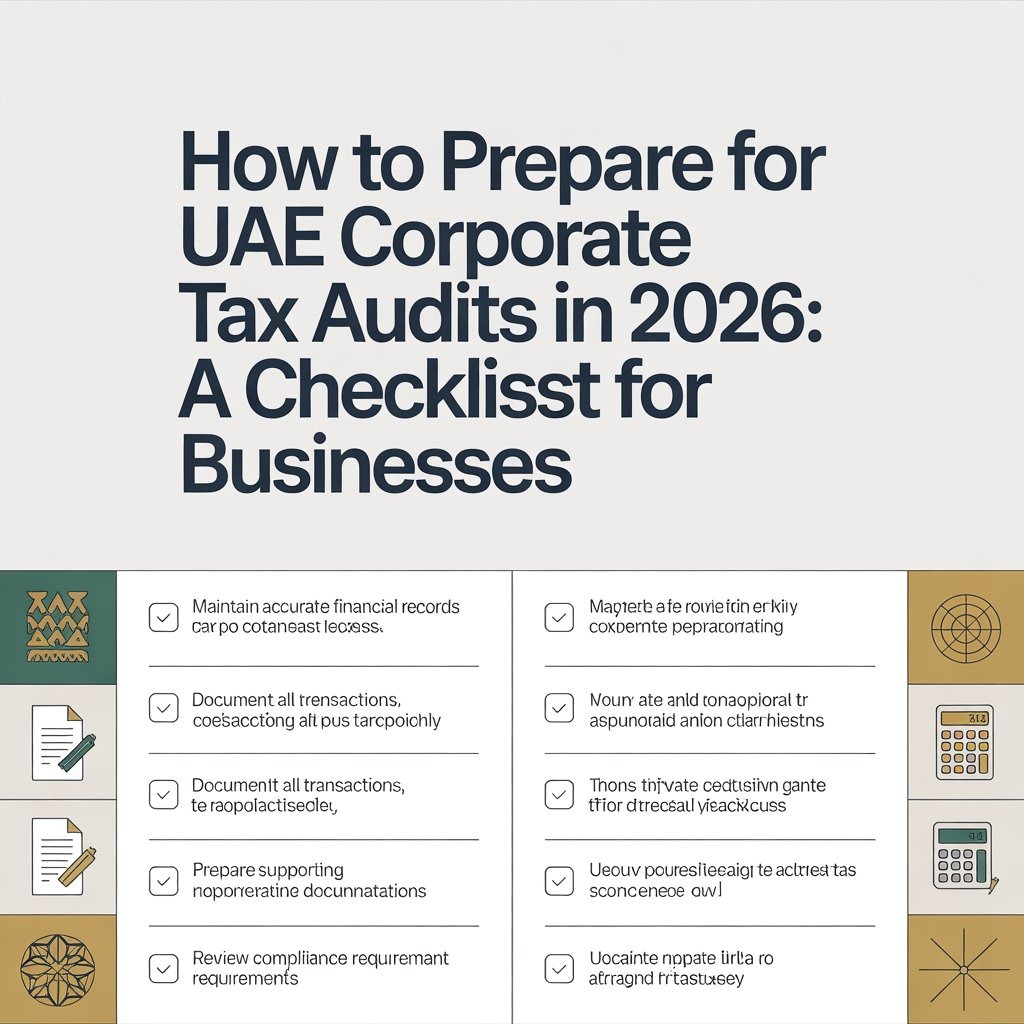
Step-by-Step Checklist to Prepare for UAE Corporate Tax Audits
This is the core section of this guide. Go through each point carefully and check whether your business is ready.
Step 1: Maintain Accurate and Up-to-Date Financial Records
This is the foundation of audit readiness. Your financial records must be updated regularly, not just at the end of the financial year.
- Record every transaction as it happens
- Categorise income and expenses correctly
- Reconcile your accounts at least once a month
- Do not mix personal and business finances
If your books are months behind, start catching up immediately. Waiting until an audit notice arrives is too late.
Step 2: Ensure Your Financial Statements Follow IFRS
The FTA expects businesses to prepare financial statements in line with International Financial Reporting Standards. This is not optional.
- Review your current financial statements with a qualified accountant
- Ensure revenue recognition, asset valuation, and expense treatment follow IFRS guidelines
- If you have been using informal or simplified accounting methods, transition to proper IFRS-compliant reporting now
Step 3: Reconcile All Accounts Regularly
Reconciliation means making sure every figure in your books matches the corresponding real-world records. This includes bank reconciliation, VAT reconciliation, and intercompany reconciliation.
- Match your bank statements with your bookkeeping records every month
- Reconcile your VAT filings with your sales and purchase ledgers
- Make sure all intercompany transactions are properly documented and balanced
Unexplained differences between accounts are one of the biggest red flags in any tax audit.
Step 4: Organise All Supporting Documentation
Every number in your financial statements needs a document to back it up. If you cannot produce evidence for a transaction, the FTA may disallow it or treat it as a misrepresentation.
- File all invoices in a logical and searchable system
- Keep digital and physical copies of key documents
- Maintain a clear record of all contracts and agreements
- Archive documents for at least five years as required by UAE law
Step 5: Review All Previous Tax Filings
Go back through your submitted VAT returns and corporate tax filings and review them carefully. Look for any errors, omissions, or inconsistencies that you may have made.
- Check that your declared income matches your financial statements
- Verify that all allowable deductions were correctly applied
- Confirm that transfer pricing rules were followed if applicable
- If you find errors, consider making a voluntary disclosure to the FTA before they discover the issue themselves
Step 6: Understand Transfer Pricing Rules
If your business has transactions with related parties or parent and subsidiary companies, transfer pricing rules apply. This is one of the most commonly misunderstood areas of UAE corporate tax.
- Document all related party transactions
- Ensure pricing is done on an arm’s length basis
- Prepare a transfer pricing disclosure form if required
- Consult a specialist if you are unsure whether your related party dealings are compliant
Step 7: Conduct an Internal Audit Before the FTA Does
Do not wait for the FTA to find problems. Conduct your own internal review of your financial records and tax compliance at least once a year.
- Review your financial statements for accuracy
- Test a sample of transactions against supporting documents
- Identify any areas where your records are weak or missing
- Fix all issues before they become audit findings
Step 8: Hire a Professional Tax Consultant or Accounting Firm
This is not a step to skip. A professional tax consultant who understands UAE corporate tax requirements can identify risks that you might miss. They can also represent your business if the FTA does launch a formal audit.
- Work with a firm that has experience with FTA audit UAE processes
- Ask your accountant to review your corporate tax filings annually
- Get professional advice on any complex transactions before you file
Common Mistakes to Avoid
Even well-intentioned businesses make mistakes. Here are the most common ones that increase your risk of an audit or create problems during one.
- Incomplete or missing records: If you cannot produce a document when the FTA asks for it, that absence itself is a compliance issue.
- Late filings: Submitting VAT returns or corporate tax returns after the deadline is one of the first things the FTA flags in their risk assessment.
- Misreporting income: Whether intentional or accidental, declaring less income than you actually earned is a serious offence that can result in heavy penalties.
- Ignoring FTA notices: If the FTA sends you a notice or query, respond promptly. Ignoring official communication makes things significantly worse.
- Mixing personal and business expenses: This is extremely common among SME owners and it creates a compliance nightmare. Keep your personal and business finances completely separate.
- Incorrect expense deductions: Claiming deductions that are not allowable under UAE corporate tax law will be flagged immediately during an audit.
Penalties for Non-Compliance
The UAE takes tax non-compliance very seriously. Here is what your business could face if an audit finds issues.
Financial Fines
The FTA can issue fines for a wide range of violations including late registration, late filing, incorrect reporting, and failure to maintain proper records. Fines can start from AED 500 and go into tens of thousands of dirhams depending on the nature and severity of the violation.
Tax Assessments
If the FTA determines that you underpaid tax, they will issue an assessment for the additional amount owed plus interest. This can be a significant financial burden especially for smaller businesses.
Legal Consequences
In cases of deliberate tax evasion or fraud, businesses and individuals can face serious legal consequences beyond financial penalties. This can include criminal prosecution in severe cases.
Reputational Damage
A tax audit that uncovers serious non-compliance can damage your business reputation, affect relationships with banks and investors, and create long-term difficulties for your company.
The best way to avoid all of this is simple. Prepare properly, maintain clean records, and work with qualified professionals.
How Leads Accountancy Can Help
Preparing for a UAE corporate tax audit is not something most businesses can do entirely on their own. It requires detailed knowledge of UAE tax laws, accounting standards, and FTA audit procedures.
This is exactly where Leads Accountancy makes a real difference.
Leads Accountancy provides comprehensive audit support and corporate tax compliance services tailored specifically for UAE businesses. Whether you are a startup going through your first tax cycle or an established company that needs to clean up years of records, their expert team is ready to help.
Their services include complete bookkeeping and financial record management, VAT filing and reconciliation, corporate tax return preparation, internal audit reviews, and direct support during FTA audits. Every service is delivered by certified accountants who understand the UAE regulatory environment inside and out.
What sets Leads Accountancy apart is their straightforward approach. They explain things clearly, communicate regularly, and never leave their clients guessing about where their business stands. When it comes to something as important as tax compliance, that level of reliability makes all the difference.
Pro Tips for Audit Readiness in 2026
Here are some expert level tips to help your business stay audit ready throughout the year, not just when you feel at risk.
- Go paperless with cloud accounting: Use a cloud-based accounting system that keeps your records backed up and accessible at all times. This makes document retrieval during an audit much faster.
- Set monthly financial review meetings: Review your financial reports every month, not just at year end. This helps catch errors early before they snowball.
- Create a tax calendar: Mark all filing deadlines on a calendar and set reminders at least two weeks in advance. Never miss a deadline again.
- Train your finance team on UAE tax laws: If you have an in-house finance team, make sure they are updated on the latest UAE corporate tax requirements. Knowledge gaps in your team become compliance gaps in your filings.
- Document every decision: If you make a judgment call on how to treat a transaction for tax purposes, document the reasoning. If the FTA asks about it later, you will have a clear explanation ready.
- Respond to FTA queries within 24 hours: Even if you need more time to gather information, acknowledge FTA correspondence immediately. This shows good faith and responsiveness.
- Review transfer pricing annually: If your business structure involves related entities, review your transfer pricing documentation every year to ensure it still reflects arm’s length practices.
Conclusion
The UAE corporate tax regime is now firmly in place and the FTA is actively enforcing compliance. In 2026, the question is no longer whether audits will happen. The question is whether your business will be ready when one comes.
The good news is that preparation is entirely within your control. Keep your records updated. Reconcile your accounts regularly. Review your filings. Organise your documentation. And most importantly, work with qualified professionals who understand UAE tax audit requirements.
A clean set of books and a well-prepared tax filing is the best defence against any audit. It also gives you peace of mind as a business owner, knowing that your finances are in order.
If you are not sure where your business stands right now, the smartest next step is to speak with a professional. Leads Accountancy is here to help you assess your current compliance position, fix any gaps, and keep your business fully prepared for whatever the FTA may review.
Do not wait for an audit notice to start getting ready. Contact Leads Accountancy today and take control of your tax compliance with confidence.